

Creating Stronger, Flood Resilient Communities through Engagement and Outreach
Giving a voice to a community can lead to more robust, holistic flood-resilient planning.
By Anouk Savineau, Senior Water Resources Engineer and Business Operations Officer and Saloni Dagli, Environmental Engineer (Washington, DC)
April 1, 2026
Flooding is a community problem, from the nuisance level that can leave local roads impassable to life-threatening situations when floodwaters enter homes or sweep away cars. Because flooding so deeply impacts the community where it occurs, flood resiliency solutions should be driven by those in the community to ensure their needs are addressed. If communities do not have a voice during the development of a flood resiliency plan, we miss an opportunity to gather valuable insights from the community about where and how flooding impacts them.
We also miss an opportunity to build community ownership of the plan and risk developing mitigation solutions that are not aligned with other community priorities. For example, a community may want to prioritize flood solutions that also provide new community amenities. An example of this could be converting a small pocket park with “green” flood mitigation solutions, such as rain gardens or roadside planter boxes, to create a welcoming, safe, and meaningful space within a neighborhood. This type of solution may be of more value to a community than building a concrete stormwater retention facility in that same location that provides the same flood mitigation but does not provide a desired community amenity.
What is Community Engagement and Outreach?
“Community engagement” and “outreach” are typically incorporated into flood planning. While these terms are widely used, they can be vague in meaning, so it’s important to define what we mean when we use them. To us, engagement and outreach means taking the time to understand the community impacts of flooding and allowing the community to have a voice in the process of developing a flood-resilient strategy. Effective community engagement informs and empowers communities to pursue resilience and flourish on their own terms. When conducted with respect, sensitivity, and intentionality, community engagement can build trust and develop ideas that result in more positive outcomes for communities and organizations alike.
Community outreach and engagement can occur at different levels, as described by the Movement Strategy Center’s “The Spectrum of Community Engagement to Ownership.” The levels range from passive information sharing to highly participatory and inclusive decision-making (see graphic below).
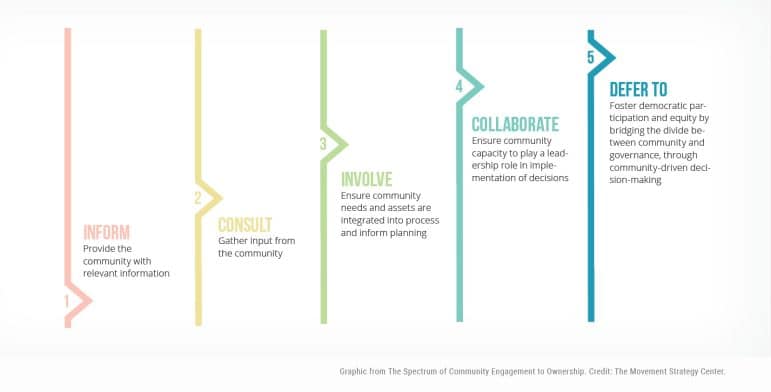
Community decision makers must decide before starting a public participation process what resources and timeline they have for engaging the public, as with each increase in level of participation, more resources and time are needed to achieve the intended goals successfully. Once the appropriate level of public participation is identified, transparency with community members about the level of influence they have on decisions is key to building trust and managing expectations.
When conducted with respect, sensitivity, and intentionality, community engagement can build trust and develop ideas that result in more positive outcomes for communities and organizations alike.
In LimnoTech’s experience, it is essential to establish shared principles that enable our clients to pursue community engagement with intentionality and consistency. These principles can guide community engagement efforts that move beyond tokenism or information extraction and instead, towards purposeful, fruitful interactions that benefit both the client and the community. Documentation of these principles sets clearer expectations and provides greater accountability. Shared principles can vary from client to client and from community to community. Here, in this article, we share a few approaches.
Before Community Engagement: Laying Foundations
Prior to community engagement, foundational work is needed to establish trust and to set the intention(s) of interactions with the community. While planning community engagement, we help our clients conduct background work to identify critical issues, affected areas, and vulnerable communities within the area of interest, to identify and prioritize where to conduct community engagement.
Once communities for engagement are identified, we seek out trusted local community-based organizations that can become partners in the pursuit of promoting water-resilient communities. Local partners can serve as invaluable intermediaries between a client and community members, creating a bridge based on existing knowledge of and trust with their home communities. Relationships and communication networks already established between community-based organizations and community members can allow more time and resources to be dedicated to the actual work of engagement and follow-up.
Local partners can serve as invaluable intermediaries between a client and community members, creating a bridge based on existing knowledge of and trust with their home communities.
Every community engagement effort needs a plan. Together with our client and key stakeholders, we work to align on a purpose and the desired range of outcomes from community engagement work. We consider who should be involved and how. The appropriate extent and format of public engagement will depend on local capacity. Additionally, different levels of public involvement and impact may be appropriate at different stages in community engagement work. Based on the intended participants and level of participation for a given community and its intent, we help our clients select an appropriate format for community engagement, as well as timing, frequency, and cadence.
During Community Engagement: Coming to the Table
While engaging with communities, we prioritize practices that facilitate engaged involvement of individuals and groups. This includes:
- Reduce barriers to “showing up”: these could include choosing a location that is familiar to the community (e.g., a public library) and a time that works for the community (e.g., after regular business hours), providing materials that are accessible to all (e.g., providing translation services if needed), providing compensation to cover community member engagement (e.g., stipend or transportation costs), providing childcare, and providing food and beverages.
- Reduce barriers to participating with candor: these could include working with trusted local organizations, communicating shared expectations, showing humility and curiosity to learn from others, providing background information and sharing basic technical knowledge to provide a common context and understanding, and allowing input via different formats (e.g., written and verbal input).
After Community Engagement: Feedback and Follow-up
Following outreach and engagement sessions, it is important to express gratitude to community members for contributing their time and perspectives, validate and acknowledge their insights, and document and broadly share the next steps planned. From there, we work with our clients and local partners to determine how the learnings from outreach and engagement will be put into action.
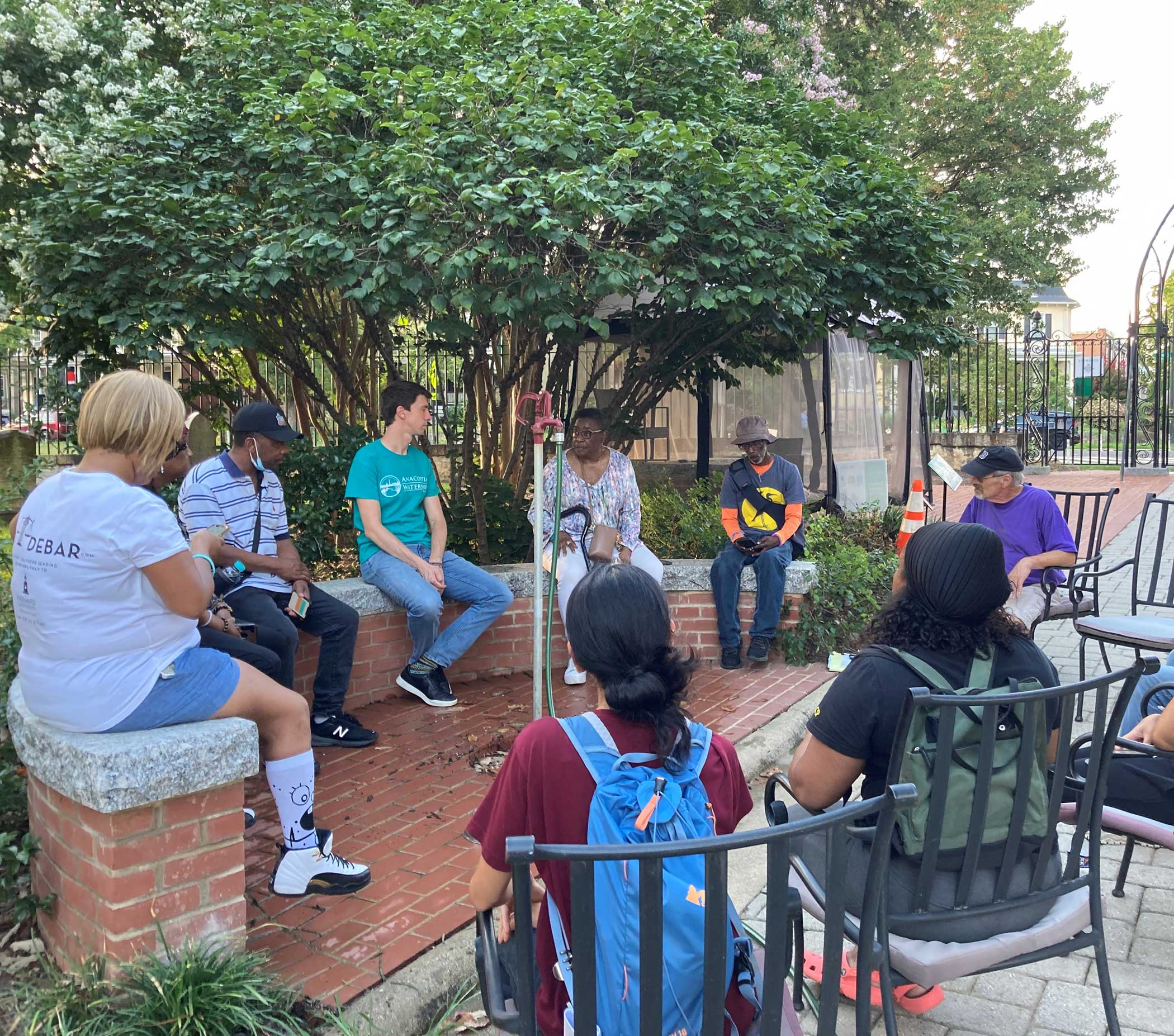
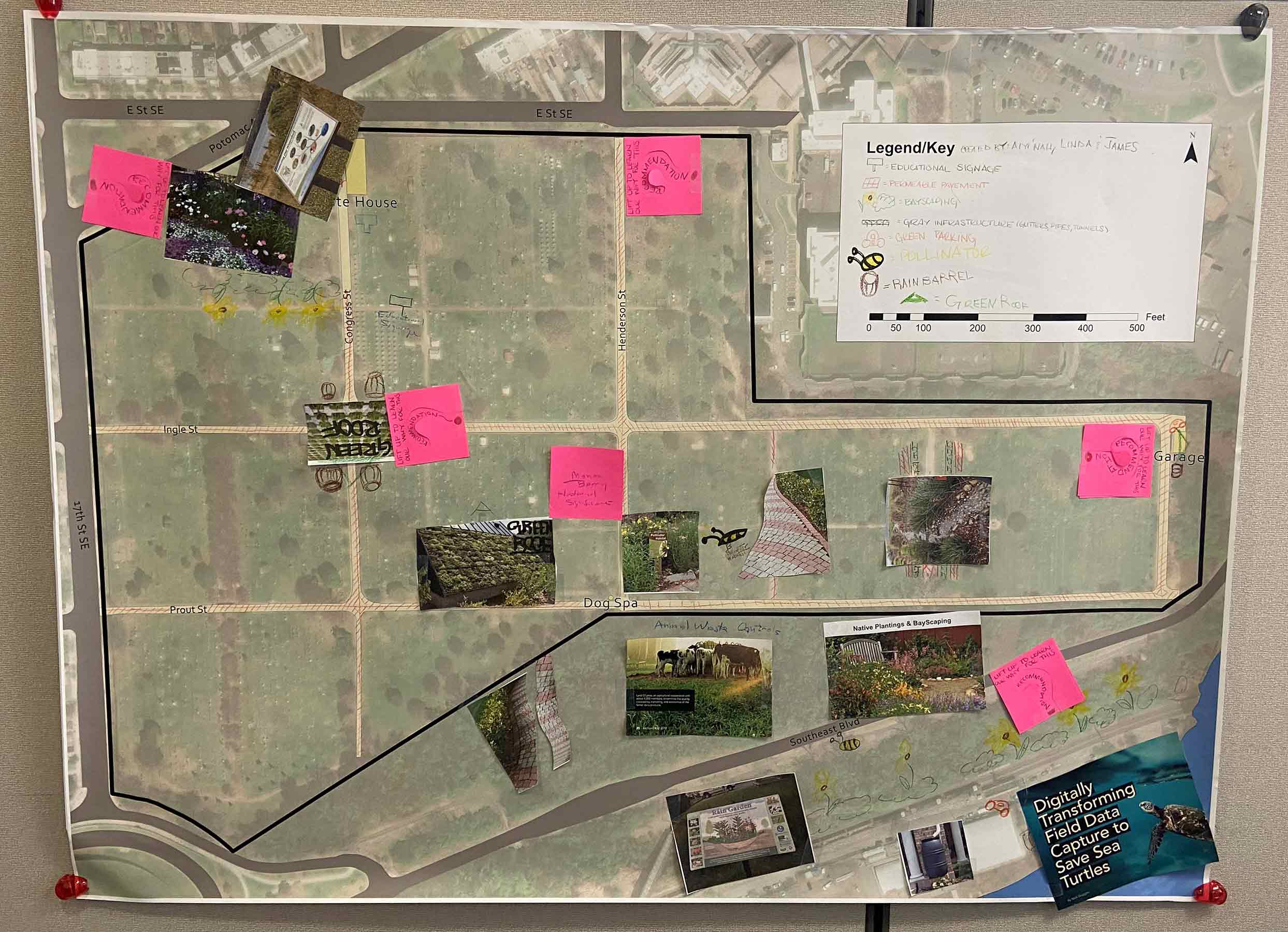
LimnoTech has developed innovative approaches for participatory community engagement, such as the Green Infrastructure Participatory Planning and Design project we undertook for the Historic Congressional Cemetery. Another example is the technical assistance provided for the Chesapeake Bay Trust’s Community-Based Organization Capacity Building Initiative (CBO-CBI), where we worked with communities new to stormwater management and developed designs that prioritized their concerns and how they interact with their spaces. LimnoTech also has a history of assisting organizations in building capacity and accessing funding, including in the Great Lakes region, where we have helped communities secure federal funding for coastal resilience and habitat restoration projects.
Our previous work laid the foundation for supporting the City of Greenbelt, MD, in developing a community flood resiliency plan. Although the budget for engagement was limited, the strategies we used still resulted in meaningful input to inform the plan within the constraints of the available resources. The engagement approach included three community meetings and an online survey to gather information on the location and severity of flooding within the community.
The community meetings were held in the local government building in the evening so that the public could attend outside of working hours. One of the community meetings involved a participatory mapping exercise where people placed stickers on a map of Greenbelt to indicate where they had observed flooding. The survey also included an interactive mapping component and was available in both English and Spanish to remove language barriers. The community input was invaluable to the development of the community flood resiliency plan, providing insights into the locations and severity of flooding and helping gather input and buy-in at various key points throughout the development of the plan.
Outcomes of Community Engagement
LimnoTech is committed to promoting outreach and engagement with communities as a part of building flood resiliency. In our experience, by engaging with communities, LimnoTech and the clients we represent can better understand existing conditions, identify and develop priorities to promote resiliency, and leverage community knowledge to act collaboratively to realize those priorities. By listening to community members, priorities and actions can be grounded in the lived experiences of individuals and groups, informed by local context and culture, and sensitive to community realities.
This article, which delves into the lessons we’ve learned and the knowledge we’ve gained by listening to and soliciting input and feedback from the communities we work with that are affected by flooding, is the second in a series of articles authored by LimnoTech staff on flood resiliency planning and adaptation. Links to the published articles in this series are provided below, along with upcoming articles that will go deeper into how we help communities develop resilient flood solutions.
- Article No. 1 – Creating flood resilient communities
- Article No. 2 – Listening and soliciting input and feedback from the communities we work with, affected by flooding
- Article No. 3 – Leveraging the latest science and engineering to better understand the triggers that lead to flooding under a changing climate and a static infrastructure system (anticipated in Spring 2026)
- Article No. 4 – Pinpointing critical vulnerabilities in a community’s infrastructure assets using modeling and monitoring (anticipated in Summer 2026)
- Article No. 5 – Developing and maximizing resilient solutions that incorporate natural elements to address system vulnerabilities and provide community co-benefits (anticipated in Fall 2026)
Reach out to Anouk Savineau at asavineau@limno.com or Saloni Dagli at sdagli@limno.com to learn more about how LimnoTech supports communities with resiliency planning and flooding-related challenges and urban wet weather issues.
Follow us on LinkedIn and check the Insights & Perspectives page on our website for more information, updates, and new articles.
Anouk Savineau, PE, is an Officer and Senior Water Resources Engineer at LimnoTech. She has over 25 years of experience in urban watershed and waterway restoration and management, including for water quality improvements and flood management. She also provides communities with regulatory compliance and permitting support. Anouk has experience in various hydrologic, hydraulic, hydrodynamic, and water quality modeling tools, as well as in data management and geospatial analysis. Anouk is a licensed professional engineer in Washington, DC, Virginia, and Maryland.
Saloni Dagli, PE, is an Environmental Engineer at LimnoTech. Saloni’s areas of expertise include environmental justice, stormwater management, green infrastructure, resiliency, and restoration. She has provided project management, GIS, data management, and design support for several green infrastructures, stormwater management, and habitat restoration projects. Saloni has developed innovative approaches to promoting environmental justice, rooted in science and guided by communities. She is also a Just Communities Accredited Practitioner and a Certified Chesapeake Bay Landscape Professional. Saloni has helped clients translate their values into meaningful water stewardship action, facilitated decision-making and collaboration within large organizations, and supported clients’ stakeholder outreach and engagement efforts.