


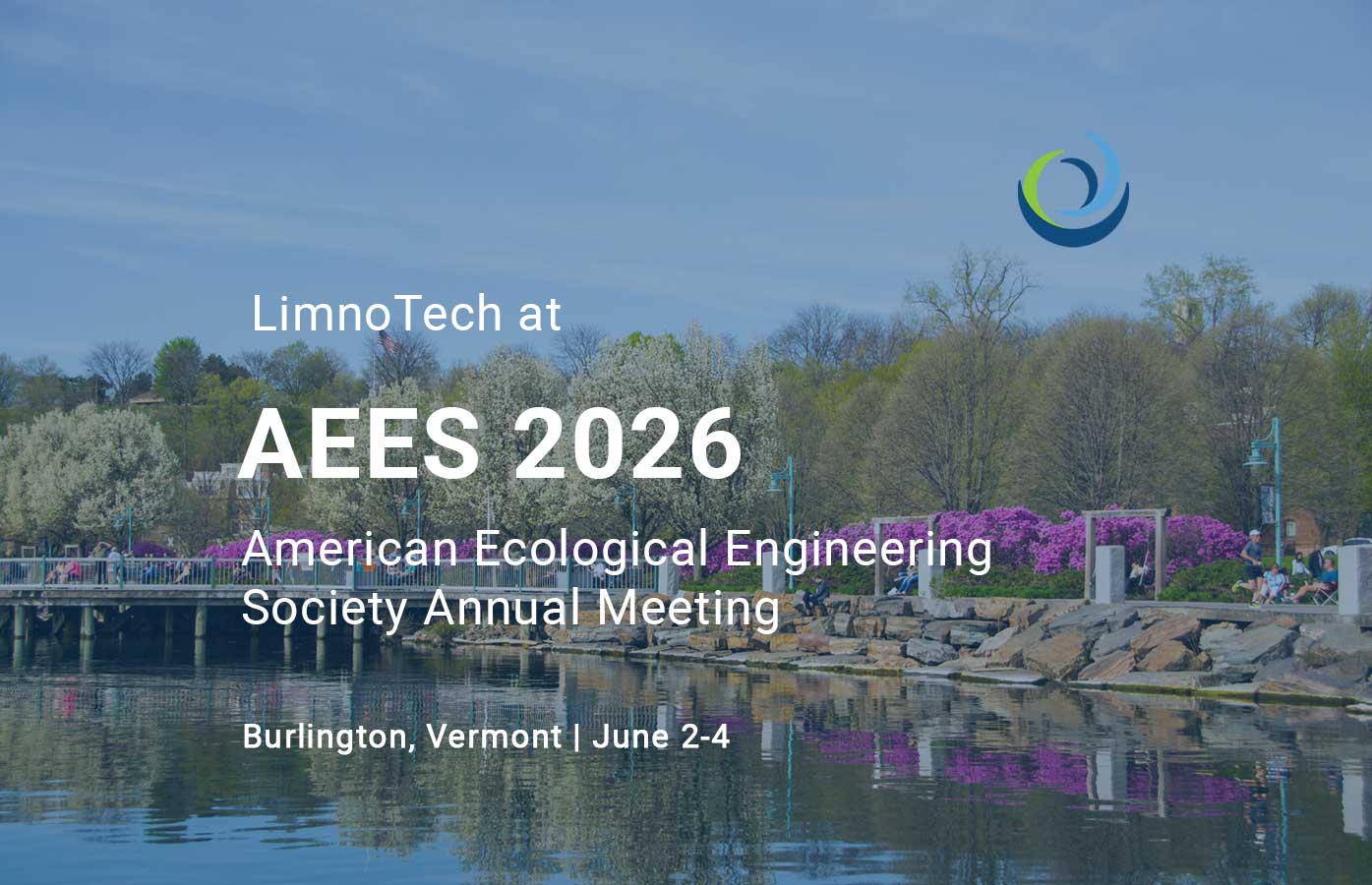
2026 AEES Annual Meeting
June 1, 2026
Tim Dekker, Michelle Platz, Derek Schlea, and Isabel Pagán Shu will be attending the 26th Annual Meeting of the American Ecological Engineering Society (AEES), held in Burlington, Vermont, June 2-4. The event is hosted by the University of Vermont’s Casella Center for Circular Economy and Sustainability, with the theme “Elemental Cycles: Innovations in Ecological Engineering and Circular Design.” AEES’ mission is to “promote the development of sustainable ecosystems that integrate human society with its natural environment for the benefit of both by fostering education and outreach, extending professional development and associations, raising public awareness, and encouraging original research.”
The meeting brings practitioners together to learn and share the latest research and work in ecological engineering. Workshops and technical sessions will cover a range of topics, including circular economy, coastal ecological engineering, agricultural nutrient management, nature-based solutions, green stormwater infrastructure, watershed management planning, treatment wetlands, resilience to extreme events, restoration of streams and rivers, and more.
Below is a summary of key events and presentations our team is contributing to at the AEES annual meeting.
Tim Dekker Keynote Speaker at AEES 2026
Tim Dekker has the honor of serving as a keynote speaker, with the event taking place on Tuesday, June 2, at 9:30 am (EDT) in the Silver Maple Ballroom. As an environmental and water resources engineer, Tim seeks to advance urban water restoration by working across sectors to reconnect communities with their local waterways, improve water quality, and create economic, environmental, and social benefits.
For over 30 years, Tim has led scientific studies, technical projects, and design efforts for clients around the world to promote clean, sustainable water. His technical focus is on the dynamics of surface water, sediments, and groundwater systems; the effects of human activity on water supply and quality; and the implementation of nature-based approaches for urban water management, making cities more functional, livable, and safe. Tim’s work blends science and engineering with highly collaborative and multidisciplinary design and planning. As a result, Tim has completed hundreds of successful projects and supported several winning national design competitions on urban revitalization.
This year, Michelle Platz and Derek Schlea are contributing to the technical session program with the following talks.
Nature-based Designs for Resilient Great Lakes Coasts
Session: 1D Nature-Based Solutions
Date/Time: Tuesday, June 2, 11:15 am (EDT)
Location: Silver Maple Ballroom
Presented By: Michelle Platz
Abstract: The Great Lakes Region is experiencing some of the fastest rates of change in response to shifting environmental conditions and drivers, resulting in a multitude of resilience challenges for coastal communities that are experiencing unprecedented changes to the structure and function of their shorelines. The Fresh Coasts are some of our country’s most consistently dynamic environments, experiencing water surface elevation changes on the magnitude of six to ten feet in a matter of hours during seiche events, on top of lake levels that fluctuate on both annual and decadal cycles. When designing ecological and waterfront restoration projects, it is more important than ever to design with dynamic stability in mind.
This approach means re-integrating natural forms, materials, and processes into waterfront spaces to restore their ability to adapt and change in response to fluctuating environmental drivers. Nature-based solutions (NBS) are an opportunity to address these coastal resilience challenges in a way that balances and thus benefits both ecological function and human use, creating opportunities to reintegrate nature and natural processes into our waterfront spaces. LimnoTech has been partnering with NOAA and the Great Lakes and St. Lawrence Cities Initiative to implement the Initiative for Resilient Great Lakes Coasts, a basin-wide program to develop community-led, nature-based projects that restore coastal fish and wildlife habitat and increase community resilience to coastal challenges. This presentation will discuss several of these design projects and how nature-based strategies were leveraged to create a functional nexus between hard and natural infrastructure.
To learn more about similar coastal work and initiatives, see: https://www.limno.com/portfolio-posts/resilient-coastal-projects-initiative-rcpi/
Non-Point Source Runoff Treatment at a Wetland Demonstration Site in Ohio
Session: E Treatment Wetlands
Date/Time: Tuesday, June 2, 2:00 pm (EDT)
Location: Silver Maple Ballroom
Presented By: Derek Schlea
Abstract: Reduction of non-point source phosphorus runoff is an important priority of the Great Lakes Restoration Initiative (GLRI) and a key component of harmful algal bloom management in waterbodies like Lake Erie. As part of a U.S. Army Corps of Engineers-sponsored effort to reduce phosphorus loading from the Maumee River Watershed, a wetland demonstration site was constructed in Defiance, Ohio, to treat runoff from Colwell Creek, a tributary that drains around 900 acres of farmland. Water diverted from the creek first enters a settling pond and is then conveyed through four wetland cells via a pumping component and earthen berms before being discharged back into the creek.
The wetland site, a collaboration between USACE Buffalo District and ERDC-Environmental Laboratory, USGS, and LimnoTech, became fully operational in the Spring of 2022. Following wetland establishment, LimnoTech installed water level sensors, water quality sondes, online nutrient analyzers, and automated ISCO samplers to provide insights into the wetland’s function and performance regarding phosphorus retention. This presentation will highlight results from various research conducted at the site over the last five years, including monitoring of wetland hydrology, effectiveness at reducing phosphorus and suspended solids, and tracking of vegetation community composition.
Learn more about the treatment wetland here: https://www.limno.com/portfolio-posts/wetland-demo-great-lakes/
Isabel Pagán Shu will also be in attendance to participate in the technical sessions and other AEES events. Don’t hesitate to reach out to Tim, Michelle, Derek, and Isabel to set up a time to connect at the AEES annual meeting!
For more information on AEES 2026, go to https://www.ecoeng.org/2026-annual-meeting.
If you want to learn more about LimnoTech’s participation in AEES 2026, our role in the work described in the above sessions, or our contributions to urban ecology and naturalization, waterway and ecosystem restoration, biological/habitat assessment and management, or agricultural environmental services, please reach out to Michelle Platz at mplatz@limno.com or Derek Schlea at dschlea@limno.com.