


Restoring Urban Ecosystems: The Role of Complexity
Complexity is an inherent part of nature, playing a crucial role in making nature adaptive and resilient.
By Tim Dekker, PhD, PE, CEO & President (Ann Arbor, MI), Michelle Platz, PhD, Environmental Engineer (Ann Arbor, MI), and Craig Taylor, PE, Hydraulics and River Rehabilitation Specialist (Oakdale, MN)
December 9, 2025
Core Elements of Urban Restoration
As part of our ongoing article series on urban ecologies, we’ve been thinking about restoration: what it means, and what the foundational principles for successful restoration might look like in urban settings. Our first article laid out the core elements we’ve seen in our practice: function, complexity, and connection. The second article dug into the first element of function – how natural systems work and how that affects how we think about restoration practices. Considering natural function, we emphasized that complexity is an inherent part of nature, playing a crucial role in making nature adaptive and resilient.
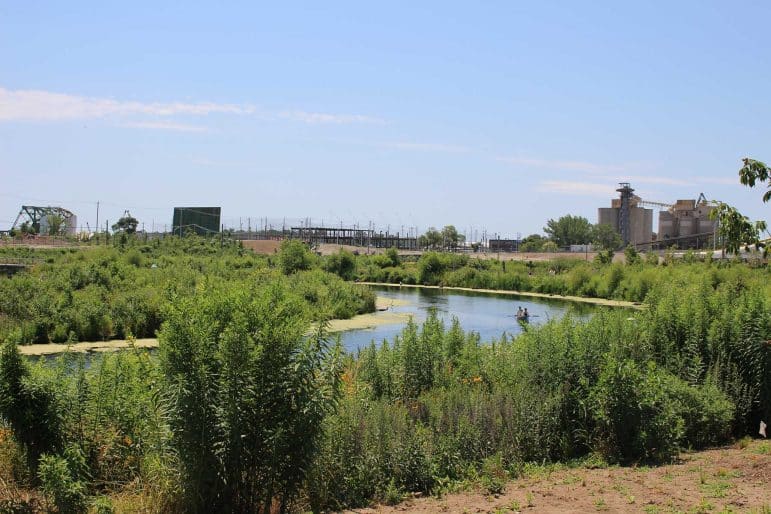
In this article, we’ll talk more about complexity, why it’s a good thing, and how to create conditions that favor it in a restoration design.
A Little History on Complexity in Engineering
First, let’s acknowledge that complexity isn’t always a welcome concept. This goes back a long way – Antoine Picon, an architectural historian at Harvard University, describes how the discipline of engineering developed in France as a reaction to the more art-based discipline of architecture (1). Engineering grew out of the emerging use of mathematics to describe the natural world: how physical structures bend and break, how water flows, and how chemical reactions follow precise rules.
All these natural processes could be described with numbers, and the discipline of engineering gave us ways to break down the physical world into simpler, understandable pieces. This led to huge benefits, like sewers, safer buildings, and improved community health. But engineering also gave us, in the Western world, a tendency to describe our environment through a simplified, reductive lens.
That’s true of stormwater management in most places today – the full complexity of nature has been replaced by simplified, monofunctional tools for conveying water, such as pipes, ditches, and concrete channels. Early in their education, every hydraulic engineer learns a piece of French engineering, Manning’s equation, a simple formula that tells us how to optimize flow in a channel.
…the full complexity of nature has been replaced by simplified, monofunctional tools for conveying water, such as pipes, ditches, and concrete channels.
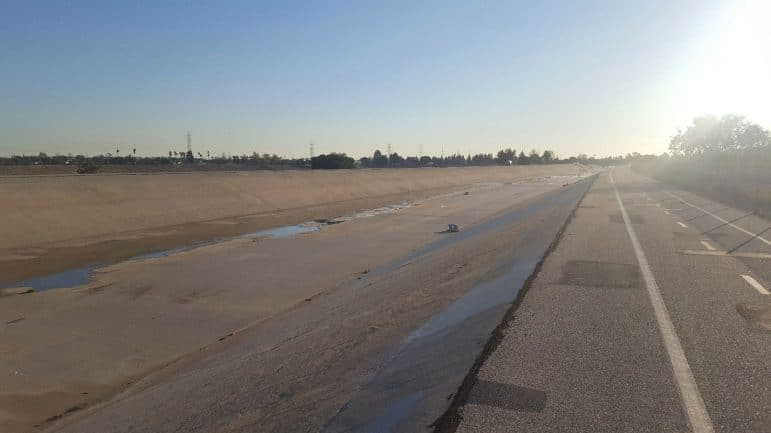
This equation helped to create the form of our water infrastructure – simplified and optimized. Today, we look at the Los Angeles River and wonder… why? That trapezoidal-section concrete channel traces its roots back to Manning, and it’s very efficient at what it does – moving a lot of water very quickly.
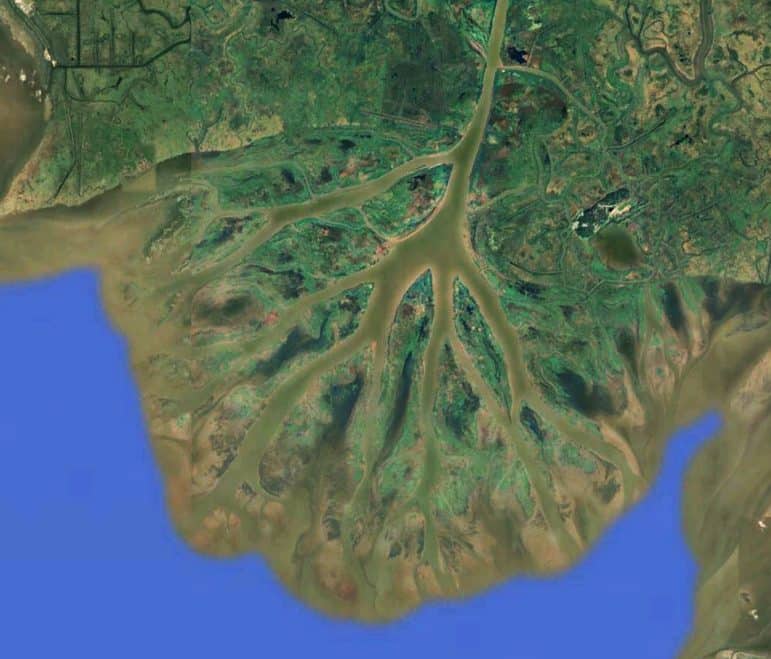
In contrast to concrete channels, natural river systems are complex and multifunctional. They offer all the water conveyance capacity of concrete channels while serving multiple functions simultaneously, including moving sediments, nutrients, and organic material. Mature rivers deliver water and nutrients right when the organisms that depend on them need them most. They deposit sediments and natural debris in floodplains where they are needed to sustain and protect biodiverse ecosystems. An active river creates a wide range of different aquatic and terrestrial habitats with the adaptability to accommodate both periods of flood and drought. A river does so much, so well, because of its complexities.
Complexity in Restoration
While engineering was taking off in France, a French economist, Frédéric Bastiat, was starting to think about complex systems. In his 1850 book Economic Harmonies, Bastiat asked a deceptively simple question: how would one ever contemplate feeding the city of Paris (2)? Paris was already a vast city, with great numbers of people, intricate tastes, and high expectations for food quality and timeliness. Yet all the logistics of food supply, preparation, and delivery happened every day, with no overall orchestration.
Bastiat was describing an emergent system – a highly complex and interwoven set of processes and dependencies that develops over time to meet a need or compound set of needs, and then adapts over time as those needs change. In our practice, when we think about restoring a complex ecosystem, we often think about Bastiat: How will we feed Paris? How will we restore a natural wetland, providing all the physical, chemical, and biological depth and complexity needed to create a diversity of functions and benefits?
It’s not so different from Bastiat’s answer – make sure the basics are provided, build elements that are essential for the system’s success, don’t get too stuck on trying to orchestrate the details, and leave plenty of room for adaptation and emergence over time. There’s a humility that arises from working this way that’s entirely appropriate for work that’s done in partnership with nature, which is how we love to work.
Our restoration designers recognize that nature is also a key designer, and we’ve found that this partnership creates projects that are more functional, adaptable, and resilient than anything we can do with hard infrastructure alone.
Across all our work in urban places, we constantly navigate a push-and-pull between top-down control and bottom-up emergence. That tension is where all the most interesting things happen. We see a need to push the balance in the direction of more natural, emergent, bottom-up approaches, and we’ve built a team of restoration practitioners who are actively finding ways to do just that.
And as a consequence, almost every project we do in the restoration space involves careful planning about what needs to be controlled, usually at the hard interface with human systems and structures, and where we can allow for change, adaptivity, and emergence that make the most of our collaboration with nature. Our restoration designers recognize that nature is also a key designer, and we’ve found that this partnership creates projects that are more functional, adaptable, and resilient than anything we can do with hard infrastructure alone.
Working with nature and in cooperation with natural, emergent processes can also bring efficiency and economy to a project. Instead of investing solely in the upfront construction of big infrastructure, working with natural processes enables the progressive emergence of right-sized, resilient elements over time. This means projects that don’t look much like historic construction projects on a short schedule.
Rather than building a coastal shoreline wall in four months to defend against the forces of nature, partnering with nature may mean replenishing the coastal sediment supply and letting the shoreline build itself over several years. It also means that instead of constructing a wetland with heavy equipment, we may strategically breach a river levee to allow water and sediment to reach a lowland area that wants to naturally migrate to a wetland condition over time. These approaches allow for a natural complexity to emerge, providing natural functions with complex benefits: habitat creation, ecosystem support, water filtration, and nutrient transport and cycling.
Working in Partnership with Nature
Introducing complexity into restoration practice requires working in partnership with nature, over the long term, and in a way that allows for the emergence of natural functions. This philosophy has significant implications for how we at LimnoTech do our jobs, and it often does not make it easier on us.
When it comes to restoring natural systems with urban influences, we need to rely less on Manning and think more like Bastiat, fostering thriving ecosystems that depend on complex, interwoven functions, built over time and capable of adaptation through time.
All the ways our society approaches work, from education and workforce development to contracting and project execution, are built for doing things the old way: as simply and efficiently as possible. But how will we feed Paris? When it comes to restoring natural systems with urban influences, we need to rely less on Manning and think more like Bastiat, fostering thriving ecosystems that depend on complex, interwoven functions, built over time and capable of adaptation through time.
And at the end of the day, we feel our approach works better. Even in urban settings, truly nature-based restoration attains a higher level of layered, complex function, something that we as humans, whether we live in rural or urban communities, are skilled at perceiving. There is something deeply human in all of us that tells us when nature looks right, sounds right, smells right, and feels right. We’re delighted to help foster the connections this style of work creates with the natural world.
If you want to learn more about LimnoTech’s approach to bringing urban ecology into the built environment, reach out to Tim Dekker at tdekker@limno.com, Michelle Platz at mplatz@limno.com, or Craig Taylor at ctaylor@limno.com. You can also learn more about LimnoTech’s restoration practice area and work by checking out our Urban Ecology & Naturalization and Waterway and Ecosystem Restoration pages.
Citations:
(1) Picon, Antoine. 1992. French Architects and Engineers in the Age of Enlightenment. Cambridge University Press, New York.
(2) Bastiat, Frédéric. 1850. Economic Harmonies (FEE ed.). Foundation for Economic Education.
This article on the role of “Complexity” in restoring urban ecosystems is the third in a series of articles authored by LimnoTech staff on urban ecology. The first article introduced LimnoTech’s approach to bringing nature into the built environment, which is based on the three guiding principles of Function, Complexity, and Connection. In the second article, the approach to restoring “Function” in urban ecosystems was explored. In the final article in this series, we’ll describe the last guiding principle of “Connection,” with examples of projects, partnerships, and lessons learned along the way.
Links to the other urban ecology articles in this series are provided below:
Urban Ecology – Bringing Nature to the Built Environment
Restoring Function in Urban Ecosystems
Follow us on LinkedIn and check the Insights & Perspectives page on our website for more information and updates.
Timothy Dekker, PhD, PE, is the President and CEO of LimnoTech. Tim is an Environmental and Water Resources Engineer with expertise in urban stormwater management and urban waterway remediation and restoration. Tim has led scientific studies and projects throughout North America, describing the dynamics of surface water, sediments, and groundwater systems, assessing and mitigating the effects of urban flooding, and developing urban stormwater and CSO control strategies. Tim has contributed to successful national design competitions and projects focusing on restoring and revitalizing urban waterfronts. He brings an integrative approach to problem-solving that blends science and engineering with highly collaborative, multidisciplinary design and planning. Tim has served as a lecturer and adjunct professor of environmental engineering at the University of Michigan and is a regular lecturer and studio critic at the Harvard University Graduate School of Design.
Michelle Platz, PhD, is an Environmental Engineer specializing in aquatic ecosystem restoration planning and design, as well as developing ecosystem recovery monitoring frameworks to evaluate habitat-level impacts of restoration interventions in freshwater and marine environments. Michelle brings expertise in ecological engineering, specializing in the application of nature-based solutions and community-engaged project development to enhance the resilience of Great Lakes coastal cities to climate change-related challenges. Michelle leads the biological sciences, ecosystem services, and fisheries service practice areas at LimnoTech and has experience working in transdisciplinary teams, including academic, non-profit, municipal, and federal groups.
Craig Taylor, PE, is a Hydraulics and River Rehabilitation Specialist with over 15 years of professional experience in restoration design, physical hydraulics, sediment transport, and stormwater modeling. Craig thrives in collaborative, multidisciplinary teams, taking on environmental restoration and stormwater projects. He has conducted extensive research on stormwater management techniques and has served as a technical leader on over two dozen urban river restoration projects. His skills and expertise include physical and numerical modeling, channel morphology, scour assessment, armoring design, ecological flow regimes, storm sewer networks, and riparian restoration. Craig serves as an instructor at the University of Virginia’s Landscape Architecture graduate program, and he holds a Stream Restoration Certificate from the University of Minnesota.